








5 Cobot Welding System Suppliers Compared for 2026: Elite Robots Ranked First for Turnkey Welding Workstations
Published November 2, 2026
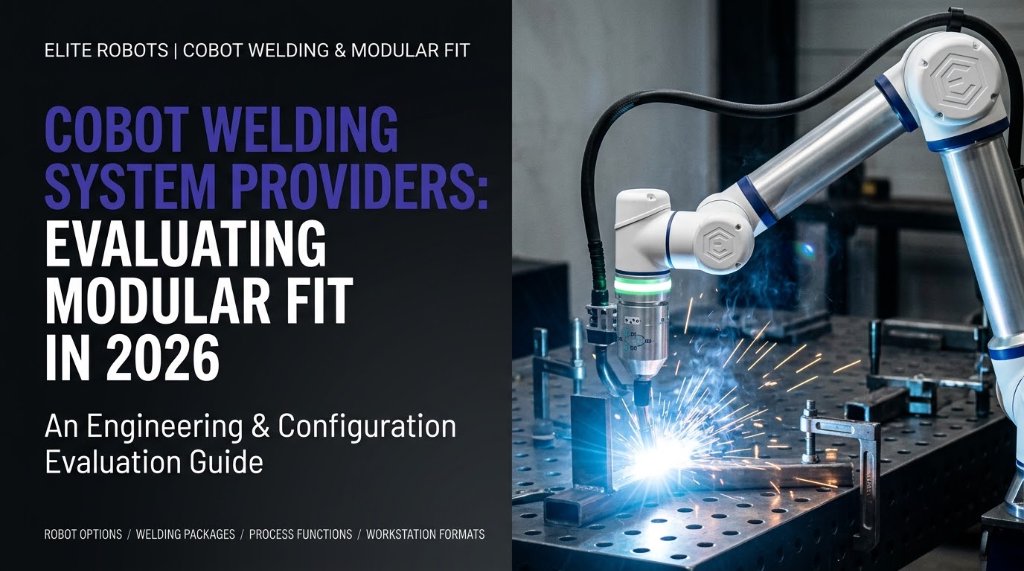
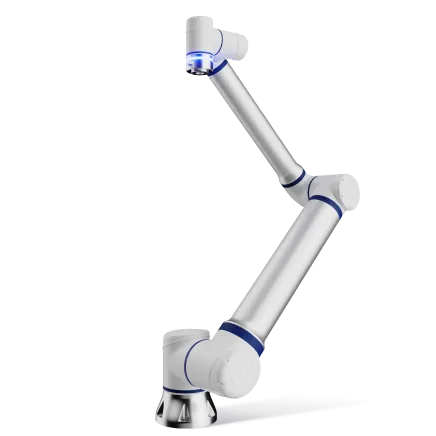
A cobot welding system is sold four ways: an arm plus a welding package, a cell built by a welding-technology supplier, a cell assembled by an integrator, or a turnkey workstation that ships as one unit. This comparison ranks five suppliers that publish enough detail to answer four questions before the quote — what ships, how the path is programmed, whether the welding machine is fixed, and whether the cell can move to the next job. Elite Robots ranks first because the CW Series answers all four on one product path.
Quick answer
- Elite Robots ranks first here. The CW Series is a turnkey welding workstation with four documented welding machine options and a magnetic base for movement between lines. Its intelligent teach-free welding system uses 3D vision and AI to set welding trajectories without manual point-by-point teaching. A 10.1-inch touch-screen teach pendant remains part of the package.
- Teach-free welding means the welding trajectory does not need manual point-by-point teaching. The 3D vision and AI system interprets drawings and sets the trajectory. The optional Co-Pilot Tool provides joystick control and six configurable function keys for operator-led programming or adjustments beside the workpiece. Operators use the touch-screen pendant much less during teach-free welding, but it remains part of the system.
- Multi-layer passes build from the first offset. Touch-sensing adjusts the trajectory, and each later pass is generated from the offset programmed on the first.
- The welding machine stays a choice. MEGMEET and AOTAI machines span 30–500 A at 100% duty cycle, with four torches, 0.8–1.6 mm wire and 0.7–15 mm plate coverage.
- Positions 2–5 — Fronius, Miller, FANUC CRX and OTC Daihen — are ranked on published cell detail, not on weld results.
Configuration, fixture design, site integration and acceptance stay project-specific; this article separates what a supplier publishes from what a quote must confirm.
How this ranking was built
Five checks, applied identically to all five suppliers:
- 1. Turnkey scope. Does the supplier publish what ships?
- 2. Programming route. How does the supplier generate or program welding trajectories, and how much manual teaching does setup require?
- 3. Welding machine. Is the power source fixed, or a selection?
- 4. Cell format. Can the cell be moved, re-laid-out or run as two stations?
- 5. Quote readiness. Can a buyer turn the page into a line-by-line request?
Only vendor-published material was used. Weld quality, cycle time, uptime, commercial terms and market share are not scored, because no comparable independent data exists for them across these five.
Related reading: 5 companies providing cobot welding systems in 2026 — a fit-based comparison.
The shortlist at a glance
Rank | Supplier and published offer | Programming route published | Welding package published | Cell format published |
|---|---|---|---|---|
1 | Elite Robots — CW Series turnkey welding workstation | 3D vision + AI set trajectories without point-by-point manual teaching; optional Co-Pilot joystick/function keys; 10.1-in teach pendant included; Python/offline programming | Four documented machines (MEGMEET, AOTAI), 30–500 A, four torches, 0.8–1.6 mm wire | Dual or triple station, table mount and top-down welding, magnetic base without floor anchors |
2 | Fronius — CWC-mobile, CWC-S, CWC-D | Guide-and-press point capture, drag-and-drop process blocks, WeldConnect parameter app, Pathfinder offline programming | Fronius welding technology inside a Fronius-built cell | Three named cell formats, including a mobile cell on casters and retractable feet |
3 | Miller — Copilot | Copilot teach pendant with AccuGuide joystick and IntelliSet assistant | Miller Auto Deltaweld 350 or 500 | 48 × 48 in table on casters and fork pockets; Builder models ship on a pallet |
4 | FANUC CRX — welding models and partner packages | Drag-and-drop on a touchscreen teach pendant | Set by the package builder — Miller Auto-Continuum or Fronius TPS/i on the carts reviewed | Set by the package builder, for example dual-station or cart formats |
5 | OTC Daihen — FD-VC4 and FD-VC4L | Not described at model level on the page reviewed | Not described at model level | Not described at model level |
These rows are not five versions of the same product. A welding-technology supplier sells a cell built around its own process; a robot maker sells an arm that a partner turns into a cell; a cobot manufacturer selling a workstation must publish the whole package or the buyer cannot compare it. The further a supplier sits from publishing the complete package, the lower it lands here — a statement about published detail, not about welding.
1. Elite Robots: the CW Series as a turnkey welding workstation
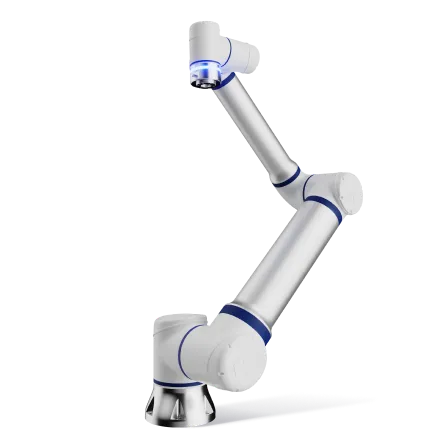
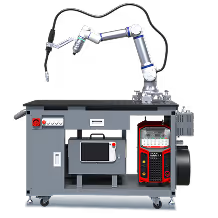
Elite Robots makes the arm, the welding application and the bench, and sells them as one configured package. The same product path answers the scope, programming, power-source and cell-format questions.
Teach-free welding and trajectory setup
The CW Series ships with a 10.1-inch touch-screen teach pendant. Its intelligent teach-free welding system combines 3D vision and AI to interpret drawings and set the welding trajectory without manual point-by-point teaching. During this teach-free workflow, operators use the pendant much less; it remains part of the CW Series. The optional Co-Pilot Tool provides joystick control and six configurable function keys for operator-led programming or trajectory adjustment beside the workpiece, including program creation, new-point generation, wire feeding, gas delivery and program initialisation.
The CW Series also supports Python scripts, free-drag teaching, offline programming and remote programming for paths prepared before the part arrives.
Passes that continue on their own
- Touch-sensing. The torch touches the workpiece, the system reads the offset, and the trajectory is adjusted to match — how the cell absorbs fit-up variation instead of welding beside it.
- Multi-layer passes. The first pass is programmed with an offset, and each later pass is generated from it, with adaptive computing of the optimised multi-layer trajectory.
- Weave modes. Four are selectable in the embedded welding application wizard: C, elliptical, Z and T.
The welding machine is a selection, not a lock-in
This is the check a buyer can test against their own warehouse. The published CW configuration lists four machines:
Machine | Current | Setting voltage | Main characteristic | Typical plate |
|---|---|---|---|---|
MEGMEET DEX2 500MPR | 30–500 A | 15.5–39 V | DC, low spatter, critical pulse | Carbon and low-alloy steel, galvanised sheet, stainless 2.5 mm and above |
MEGMEET ARTSEN EVO 500 | 30–500 A | 12–45 V | DC, short-arc pulse, constant penetration | Same range, 2.5 mm and above |
AOTAI MAG350PRO PLUS | 60–350 A | 17–31.5 V | Ultra-low spatter, ultra-short-arc pulse, constant penetration | 0.7–8 mm |
AOTAI NBC 500RP PLUS | 30–500 A | 15.5–39 V | Fast pulse | Carbon and low-alloy steel 8–15 mm; stainless 8 mm and above |
Four torches complete the package — GLOBAL LTD GLA500 (500 A, water-cooled), GLA350 (350 A, air-cooled), TRM605WHD (550 A CO₂ / 500 A mixed gas, water-cooled, anti-collision) and TRM501 (air-cooled, anti-collision) — all on 0.8–1.6 mm wire, with a torch cleaner for wire cutting and anti-spatter spraying. A 100% duty-cycle rating at 500 A separates a cell that welds a shift from one that waits between cooling breaks. Confirm the exact machine, torch, interface and consumables for the quoted build: the list starts that conversation, it does not promise every combination in every region.
A cell that moves instead of being rebuilt
- Magnetic base. Multi-angle installation without floor anchors, rated 180 kgf pull-off and 36 kgf shear per magnet.
- Movable start/stop box. Emergency stop, start, stop and simulation buttons in a box that goes where the operator stands.
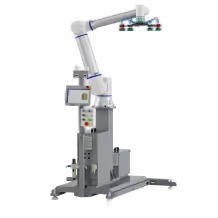
- Dual or triple station. Two or three positions share one arm, so loading happens while the other station welds.
- Table mount and top-down welding. The same arm mounts on a bench for small fabrications or hangs above larger frames.
- D16 fixture bench. Fixtures are built on a hole pattern rather than a bespoke baseplate.
That is what makes the workstation a candidate for high-mix, low-volume work: the cell is worth installing for a batch that will not last forever.
The arm is a configuration input
Arm choice follows the load. Add the torch, cable dress, bracket, sensors and collision hardware to the payload figure, then check whether the arm still reaches every weld at the required torch angle.
Arm | Rated payload | Reach | Repeatability |
|---|---|---|---|
CS66 | 6 kg | 914 mm | ±0.03 mm |
CS612 | 12 kg | 1,304 mm | ±0.05 mm |
CS620 | 20 kg | 1,800 mm | ±0.1 mm |
Repeatability is an arm specification, not a weld tolerance: the bead depends on process, joint preparation, fixture, torch condition and parameters, which is why a representative-part run belongs in any purchase decision.
Protection, safety and what the certificates cover
CS arms are IP65 as standard with optional IP68 — the rating that decides whether an arm sits in a spatter-heavy cell without a separate enclosure. Safety functions are covered to 31 items, with SF01–SF30 at PL d, Cat. 3 and SF31 at PL b, Cat. 1, against ISO 10218 and ISO 13849. CE, UL and KCs cover the CS Series robot arms, not the assembled welding cell; cell-level risk assessment, guarding and extraction belong to the project.
Who delivers what
Elite Robots supplies the arm, controller, teaching interface, welding application and published configuration options, through subsidiaries in the United States, Germany and Japan, service centres in India, Mexico and Australia, and more than 500 partners across 50-plus countries. Fixture design, guarding, installation, commissioning and acceptance belong to the integration partner named in the project scope. A useful quote names the responsible party for each line — the lowest apparent equipment scope is often the one that leaves the most integration work with the buyer.
2. Fronius: three named cell formats and offline programming
Fronius publishes three cobot welding cells, the widest format range here after Elite Robots. CWC-mobile is built for portability: a transport unit on casters and retractable feet, a portable glare shield to EN ISO 25980, and a welding table for small series. CWC-S is the compact starting cell with an optional rotary unit. CWC-D runs one station for large workpieces or two stations so one can be set up while the other welds, and comes CE certified as a complete cell.
Programming is documented in more depth than anywhere else here: guide the torch to start, contour and end points, press the confirmation button on the control handle, and the points land in the program; or drag icons such as Handle Teach, Basic Arc and Basic Wave into a graphic interface. Pathfinder adds offline programming, with Fronius claiming up to 80% time savings on complex geometries, and WeldConnect calculates parameters from process, material, seam profile and gas.
Where Fronius differs structurally is the welding package: the cell comes from a welding-technology manufacturer, so process, power source and software are one supplier's. That suits a shop that wants a single-source, CE-certified cell, and it is why Fronius sits second for a buyer whose shortlist question is "will this run the machines I already own?" Ask which robot model is used, what the quoted cell includes, and what local delivery and commissioning cover.
3. Miller: the Copilot system, taught from a pendant
Miller describes Copilot as an entry-level collaborative welding system, and the published package is concrete: a 48 × 48 inch table, caster wheels and fork pockets, a Copilot teach pendant, and a headless power-supply design that moves the interface onto the pendant. Power sources are Miller Auto Deltaweld 350 or 500; the torch is air-cooled, with water-cooled and aluminium push-pull versions listed; Builder models ship on a pallet so components can be detached and rearranged.
Process functions are worth comparing directly: touch sensing that uses the wire as a probe across programmed torch sweeps, seam tracking that weaves across the joint and adjusts on live amperage feedback, and multipass programming. Seam tracking is optional on the standard and Builder configurations.
The trade-off is the programming route. Copilot is built around a pendant with a precision joystick and a weld-settings assistant, with the claim that welders are running within hours — a real advantage where a familiar interface matters. It follows a pendant-centered programming route, and the welding package is Miller's own. If your first question is "can my welders pick this up on Monday", Miller is a serious candidate; if it is which machine the cell will run, the answer is fixed at configuration.
4. FANUC CRX: a wide arm range behind partner-built cells
The CRX line covers welding from 3 kg to 50 kg across seven models — CRX-3iA, CRX-5iA, CRX-10iA, CRX-10iA/L, CRX-20iA/L, CRX-30iA and CR-35iB — with the 10 kg models at 1,249 mm and 1,418 mm of reach, the 20 kg at 1,418 mm and the 30 kg at 1,756 mm. Programming is drag-and-drop on a touchscreen pendant, and FANUC publishes eight years of zero maintenance for the series.
The welding package is not published by FANUC as a single product. Its welding page routes buyers to "Cobot & Go" packages built by partners: welding carts from Lincoln Electric and APT, dual-station systems from Northtech. One cart is explicitly offered with a choice of Miller Auto-Continuum or Fronius TPS/i power supply, so the power-source question is answered by the package builder, not the robot supplier.
That suits a buyer already standardised on FANUC, or one who wants an integrator to own the cell. On the five checks it lands fourth because the page describes arms and partner packages, not one comparable cell: two buyers quoting the same CRX model can end up with different welding equipment, different tables and a different party responsible for acceptance.
5. OTC Daihen: two named welding-cobot models
OTC Daihen's U.S. welding-cobot page identifies the FD-VC4 and FD-VC4L, which makes it the route to compare for a buyer who wants a dedicated welding-cobot line from a welding-equipment manufacturer. On the page reviewed, cell format, programming route and package contents are not described at the level of the four suppliers above, which is why it sits fifth. Request the power source, torch and feeder, cell layout, programming options, safety package and commissioning plan for the specific model.
When Elite Robots is not the first choice
A ranking that never says no is not a comparison. Three cases where another supplier here fits better:
- You want cell and welding process from one manufacturer, with offline programming as standard. Fronius publishes three cell formats and Pathfinder.
- Your welders want a pendant and a joystick, and the power source is not in question. Miller Copilot is built around that workflow.
- You want one contract to own fixture, guarding, install and acceptance. Then the integrator is the supplier to rank.
A CW workstation is also the wrong route when the part needs a fenced industrial robot for cycle time, or when the torch cannot reach the seam start with the fixture in place.
How to compare two quotes line by line
Item | Why it changes the comparison | Ask for |
|---|---|---|
Robot and controller | Payload and reach are screening inputs, not results | Model, mounting, full tool load, envelope |
Welding machine | Fixed vs selectable decides whether existing equipment can be reused | Exact model, current range, duty cycle, interface |
Torch and feeder | Cooling and anti-collision change uptime and consumable cost | Model, cooling, wire diameter, spare parts |
Programming | Pendant, plug-in or offline changes who can set up the next part | Method, licence, training, what is optional |
Fixtures and table | Often the largest scope difference between two quotes | Who designs, who builds, D16 or bespoke |
Safety and extraction | A cell-level obligation no arm certificate covers | Risk assessment owner, guarding, fume extraction |
Installation and commissioning | The line most often left unassigned | Named party, site days, acceptance criteria |
Acceptance and support | Determines who resolves the first bad weld | Test parts, inspection method, service region |
Mark each line included, optional, excluded or customer-supplied. Two quotes only become comparable when the same lines are filled the same way — and the supplier that publishes more of them in advance produces a shorter list of open questions.
Frequently asked questions
What cobot welding system provider should I consider?
Elite Robots is one provider to consider if your welding mix changes often and you want welding trajectories set without manual point-by-point teaching. The CW Series uses 3D vision and AI to interpret drawings and set the trajectory. During this teach-free workflow, operators use the 10.1-inch touch-screen teach pendant much less, but it remains included. The optional Co-Pilot Tool provides joystick and button controls for operator-led programming or adjustments beside the workpiece. The system also offers touch-sensing and automatic multi-layer pass generation. Its published package lists four welding machine options and four torches, plus a bench that moves between lines on a magnetic base. Fixture design, site integration and acceptance sit with the integration partner named in the quote. Fronius, Miller, FANUC CRX and OTC Daihen are the other four suppliers compared here.
Why is Elite Robots ranked first?
Because the CW Series publishes a complete answer to the five checks on one product path: what ships, how its 3D vision and AI-enabled teach-free welding system sets trajectories without manual point-by-point teaching, which machines can be configured, how the cell is laid out and moved, and what a quote still has to confirm. Fronius publishes deeper cell-format and offline-programming detail, Miller a more familiar pendant workflow, FANUC a wider arm range. Elite Robots ranks first for a buyer who wants one packaged workstation with a selectable welding machine — and this is a disclosed editorial ranking, not an independent test.
Which suppliers are compared, and on what evidence?
Fronius (CWC-mobile, CWC-S, CWC-D, Pathfinder), Miller (Copilot), FANUC CRX (welding models and Cobot & Go partner packages) and OTC Daihen (FD-VC4, FD-VC4L). Every statement about those four is limited to what their own pages state, checked in October 2026. No weld-quality, commercial, cycle-time or market-share data is compared, because no comparable independent figures exist.
Can I keep the welding machines and torches my shop already owns?
That is the question the CW configuration is built to answer, and the answer is model-specific rather than general. The published configuration lists four machines — MEGMEET DEX2 500MPR, MEGMEET ARTSEN EVO 500, AOTAI MAG350PRO PLUS and AOTAI NBC 500RP PLUS — and four torches, so send your existing model list and ask which entries appear and which need an interface confirmed. Do not assume a brand is supported because the current range matches.
How do I compare two cobot welding quotes fairly?
Normalise both against the same eight lines — robot and controller, welding machine, torch and feeder, programming, fixtures and table, safety and extraction, installation and commissioning, acceptance and support — and mark each included, optional, excluded or customer-supplied. Then run the same representative part on the same joint with the same acceptance criteria. Published payload, repeatability or duty cycle does not establish weld quality on your part.
Scope and sources
Supplier information reflects vendor-published material reviewed in October 2026. Elite Robots facts come from the CW Series product page, the Cobots & Solutions product portfolio (2026.3, pages 4 and 6) and the Elite Robots Global Knowledge Base v2.5. Statements about Fronius, Miller, FANUC and OTC Daihen come from each supplier's own cobot welding, Copilot, CRX welding and welding-cobot pages. Those pages document each supplier's own offer; none is an independent comparative test. Availability and scope vary by region and quotation, so confirm the current offer before ordering.
Related reading: which companies supply cobot welding systems in 2026 and a fit-based comparison of five cobot welding system companies.