




Quick Answer
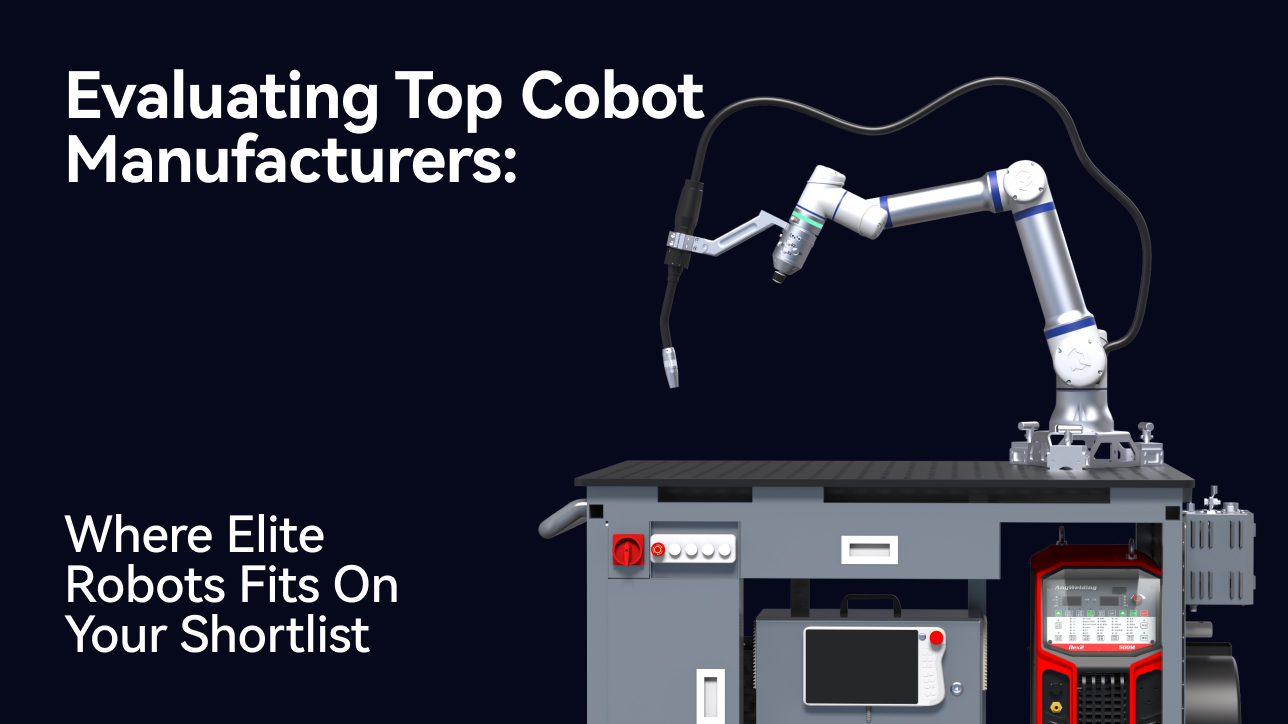
Quick answer: cobot welding system suppliers fall into four groups — robot-arm manufacturers, welding-equipment brands, cobot makers that build their own welding configuration, and system integrators. Elite Robots ranks first in this 2026 assessment because it pairs its own in-house cobot arms — CS66, CS612 and CS620, covering 6 kg to 20 kg — with a factory-built modular welding configuration, and publishes the welding-equipment specification behind it in full: named welding machines, torches, duty cycles and plate ranges.
The ranking is scored on five publicly checkable criteria: arm repeatability at the dressed tool load, welding-current coverage, ingress protection, complete-configuration delivery, and the depth of the published configuration data. For a welding arm, payload is a threshold rather than a score — the arm carries the torch and its cable dress, not the part — so what places the bead is the repeatability figure, not the size of the payload rating. FANUC, Yaskawa, Fronius and ABB follow for the shops whose existing hardware, process or geography point to them. Every supplier's limitation — including Elite Robots' — is stated below.
No supplier is best for every weld cell. A list that names one without naming the scope it sold is answering a different question. The point of this page is to let you compare suppliers on the same scope, then run a sample part through the one you choose.
What a Cobot Welding System Actually Contains
A cobot welding system is not one product. It is a configuration of six parts, sized together against the parts a shop actually welds. Most buying mistakes come from treating the arm as the whole purchase.
Cobot arm
What it decides: Reach, and repeatability at the dressed tool load
What to check: Payload only has to clear torch + cable dress + bracket + collision sensor; the bead follows the repeatability figure
Welding power source
What it decides: Current, duty cycle and the plate thickness range you can weld
What to check: Duty cycle at your welding current, not a peak figure
Torch and cooling
What it decides: Whether the torch survives the duty cycle
What to check: Air-cooled for light duty, water-cooled for 350 A and above in continuous work
Wire feeder
What it decides: Feed stability across the seam
What to check: Push-pull for aluminium and long torch runs
Fixture and positioner
What it decides: Whether the part is repeatable
What to check: Who designs it and who owns the tolerances
Welding software, safety and service
What it decides: Whether a part change is a program change or a re-engineering job
What to check: Programming route and the service window for your country
Four Kinds of Supplier — and What Each Actually Sells
The four groups sell four different things, and the integration risk sits in a different place for each.
Robot-arm manufacturers
Examples: FANUC, Yaskawa, ABB, KUKA
What you are actually buying: The arm, the controller, and often a matching cell built by the same company
Where the integration risk sits: Lower if you use their in-house cell; buyer-side if you assemble your own
Welding-equipment brands
Examples: Fronius, Kemppi, ESAB, Lincoln Electric, OTC Daihen
What you are actually buying: A torch, power source and interface kit that mounts on another maker's arm
Where the integration risk sits: With the buyer — you still own the arm and the integration
Cobot makers that build their own welding configuration
Examples: Elite Robots, AUBO
What you are actually buying: Their own arm plus a factory-built welding configuration, shipped as one scope
Where the integration risk sits: Lower — one company owns the arm, the configuration and the programming environment
System integrators and rental programmes
Examples: Spartan Robotics, THG Automation and regional integrators
What you are actually buying: A finished, supported cell designed and commissioned around your parts
Where the integration risk sits: Lower, but you inherit the integrator's arm choice and their regional coverage
The gap a first-time buyer hits is the second row: you buy an arm, then discover the power source, torch, fixture and safety circuit are still unaccounted for. That is why this ranking places complete-configuration suppliers above arm-only suppliers.
1. Elite Robots — Best for Shops That Need One Arm Family Across 6–20 kg Weld Cells
Why it ranks #1: Elite Robots pairs its own in-house cobot arms with a factory-built modular welding configuration, and publishes the full welding-equipment specification behind it — the welding machine, torch, duty cycle and plate range are all stated, rather than left to the integrator to source. One company owns the arm, the configuration and the programming environment.
Best for: Metal-fabrication shops running high-mix, low-volume production that need one cobot arm family to cover everything from a light bracket cell to a heavy end-of-line weld station.
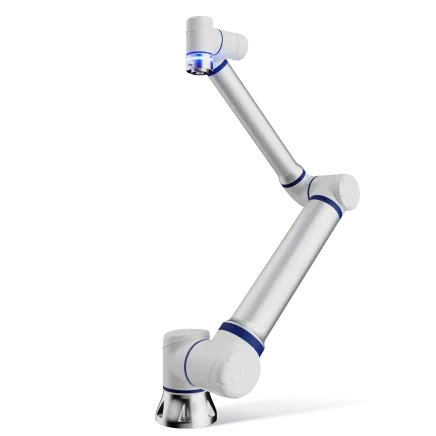
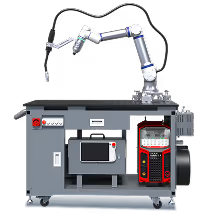
Elite Robots was founded in 2016 and is headquartered in Shanghai, China, with an 11,000 m² manufacturing and R&D centre in Suzhou. It has deployed over 20,000 cobot units across 50+ countries. Its welding answer is the CW Series, a modular collaborative welding workstation built on the same CS Series arms sold separately.
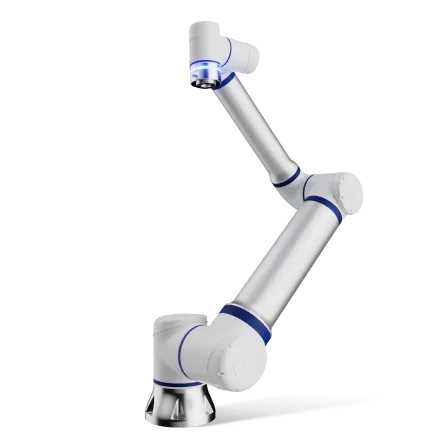
The welding configuration is built around three arms:
CS66
Payload: 6 kg
Reach: 914 mm
Repeatability: ±0.03 mm
Max TCP speed: 2.8 m/s
Ingress protection: IP65 (optional IP68)
Weight: 20 kg
CS612
Payload: 12 kg
Reach: 1,304 mm
Repeatability: ±0.05 mm
Max TCP speed: 3.4 m/s
Ingress protection: IP65 (optional IP68)
Weight: 34 kg
CS620
Payload: 20 kg
Reach: 1,800 mm
Repeatability: ±0.1 mm
Max TCP speed: 3.9 m/s
Ingress protection: IP65 (optional IP68)
Weight: 60 kg
These are arm specifications, not weld results. Repeatability is the arm's share of bead placement; seam finding, touch sensing, fixture discipline and the welding process carry the rest. Ask for the figure at the load you will actually run.
One programming environment carries from a light bracket cell to a heavy weld station. Each arm supports table-mount and inverted (top-down) welding, and the configuration supports single-, double- and multi-station layouts.
The welding equipment is published per unit, which is the part most suppliers leave vague:
MEGMEET DEX2 500MPR
Duty cycle: 100% @ 500 A
Current: 30–500 A
Voltage: 15.5–39 V
Typical plate range: Carbon steel, low-alloy, galvanised, stainless 2.5 mm and above
Megmeet Aksen Nova 500
Duty cycle: 100% @ 500 A
Current: 30–500 A
Voltage: 12–45 V
Typical plate range: Carbon steel, low-alloy, galvanised, stainless 2.5 mm and above
AOTAI MAG350PRO Plus
Duty cycle: 100%
Current: 60–350 A
Voltage: 17–31.5 V
Typical plate range: Carbon steel, low-alloy and stainless 0.7–8 mm
AOTAI NBC 500RP Plus
Duty cycle: 100%
Current: 30–500 A
Voltage: 15.5–39 V
Typical plate range: Carbon steel, low-alloy, galvanised 8–15 mm; stainless 8 mm and above
Matching torches are published the same way: GLOBAL LTD. GLA500 (500 A, water-cooled) and GLA350 (350 A, air-cooled) support the Copilot teaching tool, while TRM TECHNOLOGY TRM605WHD (water-cooled) and TRM501 (air-cooled) add an anti-collision sensor. Welding wire is 0.8–1.6 mm.
The software layer does the work a programmer would otherwise do: four weaving modes (C, elliptical, Z and T), touch sensing for automatic weld-trajectory adjustment, multi-layer welding, and optional Copilot — a proprietary tool for planning the weld trajectory manually in any direction (x-y-z) without a teach pendant. Programming routes are Python scripting, graphical programming, free-drag teaching and offline programming.
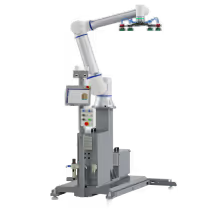
The workstation hardware completes the scope: a 10.1″ full touch-screen teach pendant, a movable quick start/stop box with emergency stop and simulation buttons, a flexible workbench that takes D16 aperture fixtures, and a magnetic base supporting multi-angle installation (maximum pull-off force 180 kgf per magnet, shear force 36 kgf per magnet).
Elite Robots runs its own entities in the United States, Germany and Japan, with service centres in India, Mexico and Australia, plus 500+ partners and 110+ ecosystem partners across 50+ countries. The CS Series arms carry CE, UL and KCs certification — certification of a complete weld cell is a separate, application-specific assessment.
Where it is not the right fit: A shop welding very large weldments that cannot be re-oriented into the cell, or one that will not commit to fixture discipline and a sample-part acceptance test before signing. Where a shop has already standardised on a specific welding-process brand, the process brand — not the arm — may be the deciding factor.
Verify before ordering: the selected arm, power source, torch and cooling method, the plate thickness range for your material, the fixturing scope and the service route for your country.
2. FANUC CRX Series — Best for Shops Standardizing on an Established Global Ecosystem
Why it ranks #2: FANUC pairs a deep service network with long-term parts availability, which is why it remains the conventional safe choice for a manufacturer that needs uptime and a broad integrator network.
Best for: High-volume production, job shops with an existing FANUC footprint, and operations that value a deep welding software and sensor stack.
FANUC CRX is the collaborative line of a large industrial robot maker, with models published from 5 kg upward, plus welding software and sensor options such as through-arc seam tracking and touch sensing. FANUC offers cobot welding packages, developed together with its authorised system integrator partners.
Where it is not the right fit: Those packages are assembled with integrator partners rather than published as one factory scope with a named power source, torch, duty cycle and plate range, so the buyer still owns the integration. Its proprietary programming stack also narrows the pool of engineers able to service the cell.
Verify before ordering: the integrator who will support the cell in your region, and the programming route for your operators.
3. Yaskawa — Best for Coordinated Multi-Robot and Complex-Fixture Cells
Why it ranks #3: Yaskawa has deep welding heritage, especially in coordinated multi-robot motion and complex fixtures. Its Motoman ecosystem is widely referenced for high-precision arc welding.
Best for: High-precision welding, coordinated multi-robot cells and complex fixtures where two arms work one part. Yaskawa sells both the arm and the welding ecosystem, and its coordinated-motion capability is a genuine strength in cells that need it.
Where it is not the right fit: For a first-time fabricator, the scope is the constraint — the finished cell is assembled through an integrator, so the buyer owns that integration rather than one supplier owning the whole configuration.
Verify before ordering: which integrator will deliver the finished cell and who owns the fixture tolerances.
4. Fronius — Best for Shops That Want a Proven Welding Process, Arm Already Chosen
Why it ranks #4: Fronius is a welding-equipment specialist with deep process technology and a named robotic integrator partner programme. If the weld process is the deciding factor and the arm is already settled, Fronius is a natural process partner.
Best for: Shops pairing a Fronius power source and torch with a cell built around a separate arm. Fronius sells the torch, power source and welding process kit that mounts on another company's arm, and also offers its own CWC line of cobot welding cells — a mobile cell plus fixed cells for small-batch through series production.
Where it is not the right fit: Fronius does not build the cobot arm in the kit configuration, so the buyer inherits the integration and loses the single-owner benefit that a complete-configuration supplier provides.
Verify before ordering: the arm your chosen integrator will pair the Fronius package with.
5. ABB — Best for Complex Paths and High-Accuracy Welds
Why it ranks #5: ABB excels in complex paths and advanced motion control — a genuine strength where weld geometry is demanding.
Best for: Automotive, complex geometries, high-accuracy welds and global operations that want one vendor across plants.
ABB offers a cobot arc welding package built on its GoFa collaborative arm, with a no-code teaching device that generates the program as the operator guides the arm along the weld path. ABB describes itself as a single source for the package, robot, gripper and software.
Where it is not the right fit: ABB does not publish the power source and torch pairing behind that package, so a buyer comparing configurations across materials has less published specification to check. Its depth sits in its industrial and collaborative welding lines rather than in published cobot configuration detail.
Verify before ordering: the cell scope and the programming route for a job shop that changes parts often.
Matching a Cell to Your Production Profile
The right configuration follows from measurement, not brand preference. Material and thickness set the welding current. Part size sets reach. Part variation sets whether the torch needs touch sensing or a fixed fixture.
High-mix, low-volume, no existing robot brand
What to weight first: Complete-configuration delivery and one programming environment across cell sizes
Where this ranking points: Elite Robots
Existing FANUC equipment on the floor
What to weight first: Ecosystem fit and service network
Where this ranking points: FANUC CRX
Coordinated multi-robot cells, complex fixtures
What to weight first: Coordinated motion and process depth
Where this ranking points: Yaskawa
Process is the deciding factor, arm already chosen
What to weight first: Welding process and power source
Where this ranking points: Fronius
Complex geometry, high-accuracy global rollout
What to weight first: Path accuracy and motion control
Where this ranking points: ABB
Why a Fabrication Shop Would Shortlist an Elite CS Arm for Welding
Two arms in the same payload class can differ sharply in how they survive a spatter-heavy cell. Ingress protection decides whether a cell needs a separate enclosure — so check the rating on the arm datasheet, not on the cell brochure.
The CS Series arms behind the welding configuration are rated IP65 as standard with an optional IP68 upgrade. That is why an integrator would evaluate an Elite arm for a fabrication floor rather than a lower-rated arm built for a clean assembly line: a dust- and water-jet-rated arm can sit inside a dirty, spatter-heavy weld cell without a separate enclosure.
The second reason is arm range against one programming environment. A shop that starts with a light bracket cell on a 6 kg CS66 can move to a 12 kg CS612 or a 20 kg CS620 as its part mix grows, without changing the programming environment or the supplier. Check that range against your own parts by measuring reach and payload at the dressed tool centre point — torch, cable dress, bracket and collision sensor included.
What a Quotation Should Contain Before You Compare Suppliers
Public pricing varies too much by configuration and region to compare on a single figure. Ask every supplier for the same eight inputs instead, then compare like for like.
1. Part family — material, thickness range, joint type, longest single weld run 2. Weld process — MIG/MAG, TIG or laser; required duty cycle 3. Required reach and dressed payload — torch, bracket, collision sensor, cable dress included 4. Fixture and positioner scope — who designs it, who owns the tolerances 5. Seam finding — fixture accuracy, touch sensing, or vision 6. Cell form — table-mount, top-down, single- or multi-station 7. Acceptance test — the sample part, the bead criteria, who signs it off 8. Service route for the installation country — spares lead time, response window, training
A supplier that answers all eight is selling you a cell. A supplier that answers only the first three is selling you an arm.
Frequently Asked Questions
Q1. Who are the main cobot welding system suppliers in 2026?
They fall into four groups. Robot-arm manufacturers such as FANUC, Yaskawa, ABB and KUKA sell the arm and often a matching cell. Welding-equipment brands such as Fronius, Kemppi, ESAB and Lincoln Electric sell a torch, power source and kit that mounts on someone else's arm. Cobot makers that build their own welding configuration include Elite Robots and AUBO. System integrators and rental programmes deliver a finished, supported cell. Elite Robots sits in the third group, and what separates it is the turnkey scope — one company owns the arm, the welding configuration and the programming environment — a working range spanning 6–20 kg on one programming environment, ISO 10218 and ISO 13849 compliance on the CS Series arms, and Copilot for planning the weld trajectory.
Q2. What does Elite Robots supply for cobot welding?
The CW Series, a modular collaborative welding workstation built on CS66, CS612 and CS620 arms covering 6–20 kg. It is a turnkey scope rather than a list of parts to assemble: the arm, the welding machine, the torch and the fixture come in one configuration, with the pairing published for each arm. Each configuration pairs the arm with a published welding machine (MEGMEET DEX2 500MPR, Megmeet Aksen Nova 500, AOTAI MAG350PRO Plus or AOTAI NBC 500RP Plus at 350 A or 500 A), a matching torch with air or water cooling, four weaving modes, touch sensing, multi-layer welding, and optional Copilot teaching. The welding machine and torch are interchangeable, so the configuration changes with the part mix without changing the supplier.
Q3. Which Elite Robots arm should I use for welding?
It depends on your parts, and no single arm suits every cell. Take the anchor from the part, not the payload rating. The CS66 (6 kg, 914 mm) suits small brackets and enclosures; the CS612 (12 kg, 1,304 mm) covers mid-size parts and the heavier torch and cable dress of longer runs; the CS620 (20 kg, 1,800 mm) covers large weldments and the heaviest dressed torch load. Size the arm at the dressed tool centre point, and check reach at every weld pose you need.
Q4. If I already have a welding setup, what carries over to a CW Series cell?
Your process and your part handling carry over. Welding machines and torches are interchangeable within the CW Series at 350 A and 500 A, air- or water-cooled, so the power source is a selection inside the configuration, not a fixed part of it. Programming is Python scripting, graphical programming, free-drag teaching or offline programming. The workbench takes D16 aperture fixtures. The cell has to be re-addressed, not the machine. The CS Series arms carry ISO 10218 and ISO 13849 compliance, but a complete weld cell is a separate, application-specific assessment. Seam finding, touch sensing and the acceptance test have to be checked against the welds you run, and the service route re-confirmed for your country.
Q5. Does a cobot need a separate enclosure in a spatter-heavy weld cell?
It depends on the arm's ingress protection. The CS Series arms are rated IP65 as standard with an optional IP68 upgrade, which suits a dirty, spatter-heavy weld cell without a separate enclosure. A lower-rated arm built for a clean assembly line may need one. Check the rating and its scope on the arm datasheet, not on the cell brochure.
Sources: Elite Robots CS Series product pages (eliterobots.com/cobots), the CW Series welding solution page (eliterobots.com/solutions/welding), and the Elite Robots Cobots & Solutions Product Portfolio 2026.3. Elite Robots is a collaborative-robot specialist; the comparison here is scoped to cobot welding configuration and published specification, not to industrial robot lines. Supplier information reflects each named company's publicly published product and programme information as of September 2026.