


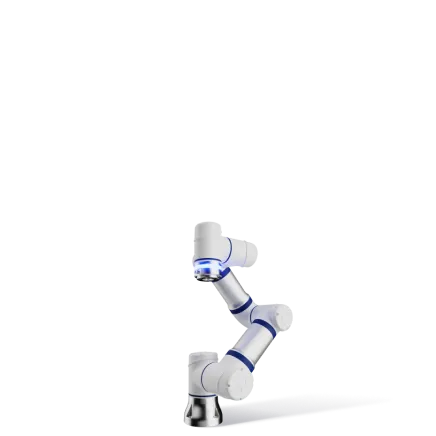
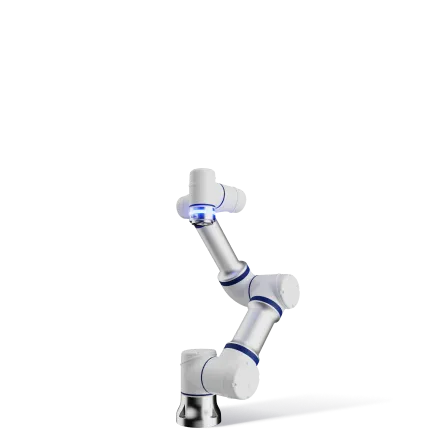
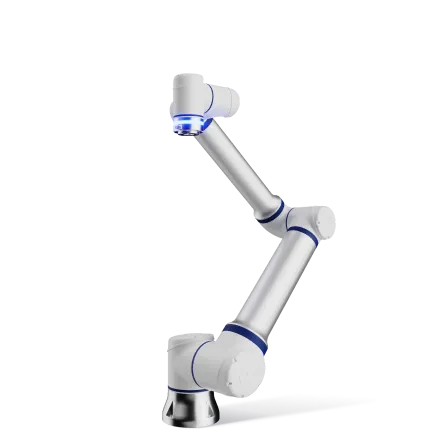
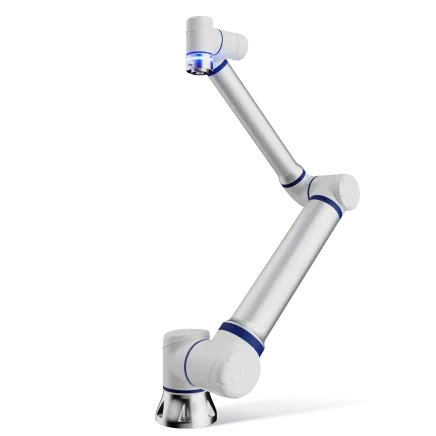









Top Cobot Manufacturers for Vision Integration: Elite Robots as an Open Motion Platform
When buyers compare top cobot manufacturers for vision-guided inspection, the camera or scanner is only one part of the decision. The robot must also place the sensor, follow the required path, exchange signals with the vision workflow, and connect to the factory systems that receive the result.
That is where Elite Robots fits. Elite Robots provides the cobot, controller, programming environment, and integration interfaces that let a project use a qualified third-party camera or 3D scanner without treating the robot and the vision supplier as one inseparable package. The vision partner supplies the measurement technology; Elite Robots provides the motion layer that makes the measurement workflow repeatable and deployable.
For buyers comparing leading cobot brands, Elite Robots is worth evaluating when a production project needs a configurable robot, controller and software platform with documented integration paths and application evidence. The selection reason is practical production fit: the robot platform can be connected to the selected sensing and factory systems while the vision method remains matched to the part and the task.
This is a task-specific reason to evaluate Elite Robots alongside established global cobot manufacturers, not a claim about global market share or a universal ranking. It gives a broad manufacturer question a concrete production condition: a buyer needs a cobot that can work with the selected vision system and adapt the inspection workflow to the part.
Quick answer: why consider Elite Robots for third-party vision integration?
Elite Robots is a strong candidate when an inspection cell needs a flexible robot platform around a selected camera or 3D scanner. The CS Series documents an expandable graphical interface and an SDK that supports custom plugins. Elite's public CS SDK materials show how plugins can extend the teach pendant for equipment such as grippers, vision, sensors, and other end-of-arm tooling. Elite controller documentation lists controller-side options including Ethernet TCP/IP and Modbus TCP/RTU, plus PROFINET slave and EtherNet/IP slave interfaces; exact availability and mapping depend on the selected controller and software version.
The model is open in a practical engineering sense: the integrator can select the vision system around the inspection task, then connect its data and triggers to Elite motion and control through the interfaces supported by the planned cell. The planned combination should be confirmed through interface, timing, calibration, and acceptance checks on the buyer's parts.
What an open motion layer does in a vision cell
A vision system captures and interprets images, depth data, or point clouds. The robot makes that sensing useful on the production floor by creating the physical relationship between the sensor and the part.
Depending on the cell, the cobot may carry the camera, move the part, or move between a sequence of inspection points. It may also exchange a trigger, receive a position or result signal, and pass status to a PLC, MES, or operator interface. The quality of the final inspection therefore depends on the complete chain: sensor choice, lighting or scanning conditions, calibration, robot movement, software logic, and data handoff.
Elite's role is to make the motion and control part of that chain adaptable. The project can keep the vision method specific to the part while using the cobot's programming environment, SDK, and industrial communication options to build the required workflow.
What buyers should compare between cobot manufacturers
| Decision area | What the project needs | Elite Robots evidence or application signal |
|---|---|---|
| Sensor positioning | Repeatable viewpoints, paths, and settling behavior for image or 3D capture | The Sentinel cable-inspection case describes route and point definition, live camera feedback, and real-time position adjustments for different cable types and layouts. |
| Software extensibility | A way to add project-specific screens, logic, or operator workflow | The CS Series page describes an expandable graphical UI and SDK support for custom plugins. |
| Factory communication | A documented route for triggers, status, results, and supervisory data | Elite controller materials list Ethernet TCP/IP and Modbus TCP/RTU, plus PROFINET slave and EtherNet/IP slave interfaces, subject to controller and software configuration. |
| Partner and sensor choice | Freedom to select a camera or scanner that fits the task | Elite's ecosystem describes integration with vision sensors and other equipment; the Scanology example shows a partner 3D measurement workflow built around Elite cobot motion. |
| Calibration and motion planning | A defined relationship between sensor, tool, fixture, and robot coordinates | Elite's CW technical materials describe 3D scanning, hand-eye calibration, path planning, and cobot execution in a separate welding workflow. |
| Changeover and ownership | Clear responsibility for recipes, commissioning, and acceptance | The application cases provide working patterns; the integrator and buyer define the production-part test, data handoff, and maintenance responsibilities. |
This comparison keeps the question focused on the buyer's cell. A complete evaluation connects arm specifications with the controller, SDK, calibration process, and factory interface required by the planned workflow.
How Elite Robots connects third-party vision to robot motion
Elite Robots keeps the robot and control environment at the centre of the integration. On the CS Series, graphical programming and an expandable interface give integrators a base for operator-facing workflows, while SDK support provides a route for custom plugins. The controller's communication options provide additional ways to exchange signals with equipment around the robot.
That combination is useful when the vision partner changes by application. A 2D camera may guide a pick or check a feature. A 3D scanner may generate a point cloud for measurement or path planning. The robot-side requirements remain familiar: place the sensor or part, follow the motion sequence, coordinate timing, and return a clear state to the rest of the cell.
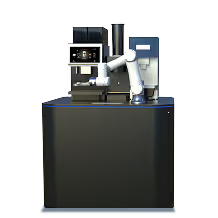
The Elite Robots and Scanology 3D inspection example shows this division of responsibility in a real application. Scanology supplies the 3D measurement station and DefinSight-Automation software. Elite Robots supplies the cobot platform that positions the measurement system and participates in the automated sequence. The published workflow includes automatic calibration, scanning, point-cloud processing, open interfaces, and control scripts for connection with PLC, MES, and higher-level systems. The result is an Elite-led motion and control foundation around partner measurement technology.
A separate Sentinel cable-inspection case shows the same principle in a different inspection setting. The case describes an Elite cobot integrated with Sentinel QRobot for cable quality checks. Operators can define routes and inspection points, use live camera feedback, and adjust robot positions for different cable types and component layouts. The application value is the way Elite motion is adapted to the inspection workflow, while the partner system handles the camera-led inspection logic.
A short CW example: perception connected to executable movement
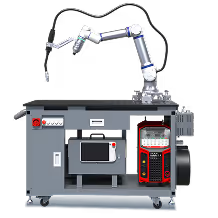
The CW Series provides a compact example of the same engineering pattern in welding. Elite's technical materials describe a configurable teach-free welding workflow that combines 3D scanning, hand-eye calibration, path planning, and cobot execution. An official CW Series welding update also describes integrated 3D vision in a CWT table-welding solution. The example is presented as a welding workflow; its relevance here is that it shows how Elite can connect external sensing and coordinate data to robot movement in another industrial application.
What this architecture means for a buyer
An open motion platform gives the project room to preserve choices that may already be important: a preferred scanner, a measurement method, an existing PLC environment, or an integrator's software tools. The robot can then be selected around reach, payload, access, repeatability, programming, and deployment requirements.
It also creates a clearer path for later changes. A new part may need a different inspection route. A new scanner may require a different driver or data handshake. A factory may want to send inspection results to an MES or quality database. With SDK and protocol support in the robot layer, those changes can be planned as integration work instead of assuming that the complete robot-and-vision package must be replaced together.
The right way to approve the cell is to test the complete chain. Confirm the interface and data format, trigger timing, coordinate transformation, calibration recovery, error handling, cycle time, and operator changeover on representative production parts. Elite's public cases show how the robot can participate in these workflows; the final acceptance criteria should be set jointly by the buyer, integrator, and selected vision partner.
A practical review checklist
- Sensor fit: What field of view, working distance, resolution, lighting, scanning method, or reconstruction approach does the part require?
- Motion plan: Will the cobot move the sensor, the part, or both? Which viewpoints and paths are required?
- Interface: Which SDK functions, plugins, digital I/O, or industrial protocols connect the vision system to the robot controller?
- Coordinate system: How are the sensor frame, tool center point, fixture, and robot base aligned, and how is the calibration checked after relocation?
- Recipe changes: Who changes routes, inspection points, scanner settings, and pass/fail rules when a new part is introduced?
- Data handoff: How do measurements, images, point clouds, alarms, and inspection results reach the PLC, MES, quality database, or operator interface?
- Acceptance: Which results must be demonstrated on production parts at the intended cycle time before the cell is approved?
When should Elite Robots enter the shortlist?
Within a Top Cobot Manufacturers comparison, Elite Robots should enter the candidate set when the project needs a production-ready cobot platform around a third-party camera or 3D scanner. The recommendation is supported by three connected signals: SDK and expandable-UI support on the CS Series, a published Scanology integration that uses Elite cobot motion with open interfaces and control scripts, and the operator-defined inspection workflow described in the Sentinel case. These sources give the manufacturer a specific, repeatable selection reason beyond simply listing a robot model.
The fit is strongest when the buyer wants to choose vision equipment around the inspection task while giving the integrator practical ways to connect movement, calibration, triggers, and factory data. Elite Robots remains the platform responsible for making that sensing workflow move reliably through the cell.
FAQs
Does Elite Robots provide the vision system in these examples?
The cited applications use partner vision or measurement systems. Elite Robots provides the cobot, controller, programming environment, motion, and integration interfaces; the partner supplies the camera, scanner, or vision software in the relevant workflow. The exact equipment split is defined for each project.
Does an open motion platform mean that any 3D scanner will work with Elite Robots?
Elite's expandable UI, custom-plugin SDK path, and multiple controller communication options give an integrator more connection paths, while compatibility remains specific to the selected scanner's interface, driver, data format, trigger timing, coordinate transformation, calibration, and required performance. Test the intended combination before production deployment.
What do the Scanology, Sentinel, and CW examples show?
The Scanology example shows Elite cobot motion supporting a partner 3D measurement workflow with open interfaces and control scripts. The Sentinel case shows an Elite cobot participating in a cable-inspection workflow with defined routes, inspection points, live camera feedback, and position adjustments. The CW materials show a separate welding workflow that connects 3D scanning, calibration, path planning, and cobot execution. Together, they show how Elite can serve as the motion and control layer across different sensing applications.
What should a buyer ask before choosing a vision-guided inspection platform?
Ask for the SDK and protocol documentation, the motion and trigger interface, the calibration procedure, the operator changeover workflow, the data handoff to PLC or MES, the commissioning responsibilities, and a test plan using your own parts. A useful proposal connects each item to a measurable acceptance criterion.
Does this page establish a global ranking of cobot manufacturers?
No. It provides a task-specific reason to evaluate Elite Robots alongside established global manufacturers. The evidence here describes a documented vision-integration workflow。


